
AuthorProof
- Company
- Proctorio
- Role
- Staff Product Designer, end to end
- End-to-end Product Design
- Prototyping
- Systems Thinking
- Accessibility
- Figma
- Claude Code
- Institutions in the spring 2026 pilot
- 4 to 6 wks
- From brief to production-ready MVP
- Steps added to the instructor's grading workflow
- Seconds
- From upload to quiz in the adopted long-term flow, down from about ten minutes
An LMS-integrated integrity tool that verifies authorship through personalized comprehension quizzes generated from each student's own submission.
- 01The questionDid you write this, not is this original
- 02The constraintsFour, found before engineering spent time
- 03The pivotA smaller flow that kept the promise
- 04ShippedScore and confidence where instructors grade
Where it sits
Proctorio's integrity suite is three products: Integrity proctors the exam, Vault protects its content, and Origin proves authorship. I led design across all three. AuthorProof is Origin's product, and I took it from an assigned brief to a shippable MVP.
Integrity
Proctor an exam securely
Proctorio suite
Vault
Protect your exam
Proctorio suite
Origin
Prove the work is theirs
Today’s walkthrough
Did you write this?
Existing integrity tools ask whether a paper is original. A paraphrase, an AI rewrite or a ghostwriter clears every one of them. None ask what instructors want to know: did you write this?
AuthorProof asks it directly. When a student submits written work, it builds a short quiz from that writing, in the language it was written in. Someone who wrote the paper can answer questions about it; someone who didn't, can't. The score appears beside the submission, where instructors already grade.
The brief as it arrived
The brief came with its architecture chosen: three journeys built on the LMS's own quiz tool, one quiz per submission, and a notification telling the student to go find it.
- 01
Opens the assignment in the assignment editor
- 02
Enables AuthorProof and configures the quiz
- 03
Publishes the assignment
Before engineering spent time on it, I mapped the flow step by step and timed it against what the platform could do.
6
Steps between submission and quiz
~10 min
Latency those steps add up to
Per student
A fresh quiz each, in tooling built for one per class
Four constraints that moved the product
- 01The quiz tool is one-to-many.
It expects one quiz written once for a whole class. A new quiz per submission fights that at every step, and breaks when a class submits at once.
- 02Ten minutes is enough to cheat.
Fetching, generating, creating, assigning and notifying took about ten minutes. That is all the time a student needs to reread their essay.
- 03Students turn notifications off.
The fallback was instructors reminding students, which loads the work onto the person we were trying to help.
- 04Two things to grade.
A separate quiz would sit apart from the submission, with no single view for the instructor.
Each one was about where the product lived, so the fix was a different flow.
A smaller flow that kept the promise
Instead of reporting the blockers, I pitched an alternative, split into an MVP and a longer vision. The MVP puts AuthorProof inside the assignment: the student uploads their essay and the quiz appears seconds later.
- 01
Student starts the assignment
- 02
Uploads the essay into the AuthorProof LTI
- 03
The quiz appears, seconds later
- 04
The assignment shows as completed once the quiz is done
What it fixed
One move, three constraints
- The ten-minute gap closed to seconds
- No notification to miss
- Out of the quiz tool, with the result written back beside the submission
What it cost
Named up front
- Short pieces written in the LMS editor were left out
- How proctoring would work alongside it was still open
- I flagged both before engineering could find them
Proctorio shipped the briefed architecture first, as the fastest way to put a working product in front of pilot instructors, and adopted the embedded flow as the product's long-term direction.
Built for a conversation
The result had to support a conversation between an instructor and a student, never judge the student on its own.
No pass or fail
A score ships with a confidence level, and the instructor decides what to do with it.
Show what was asked
Every question sits beside the words that prompted it and the assessment of the answer, so instructors can check the AI's reasoning for themselves.
Never color alone
The host platform colors the badge the opposite way from the score, so the score, label and confidence always appear as text.
The prototype was the spec
I led design end to end, from concept to a production-ready MVP in four to six weeks. I designed the quiz settings, the report card, the results and the student emails, and built working prototypes of all of it in HTML, CSS and vanilla JavaScript on our design system. Engineering built from the prototypes.
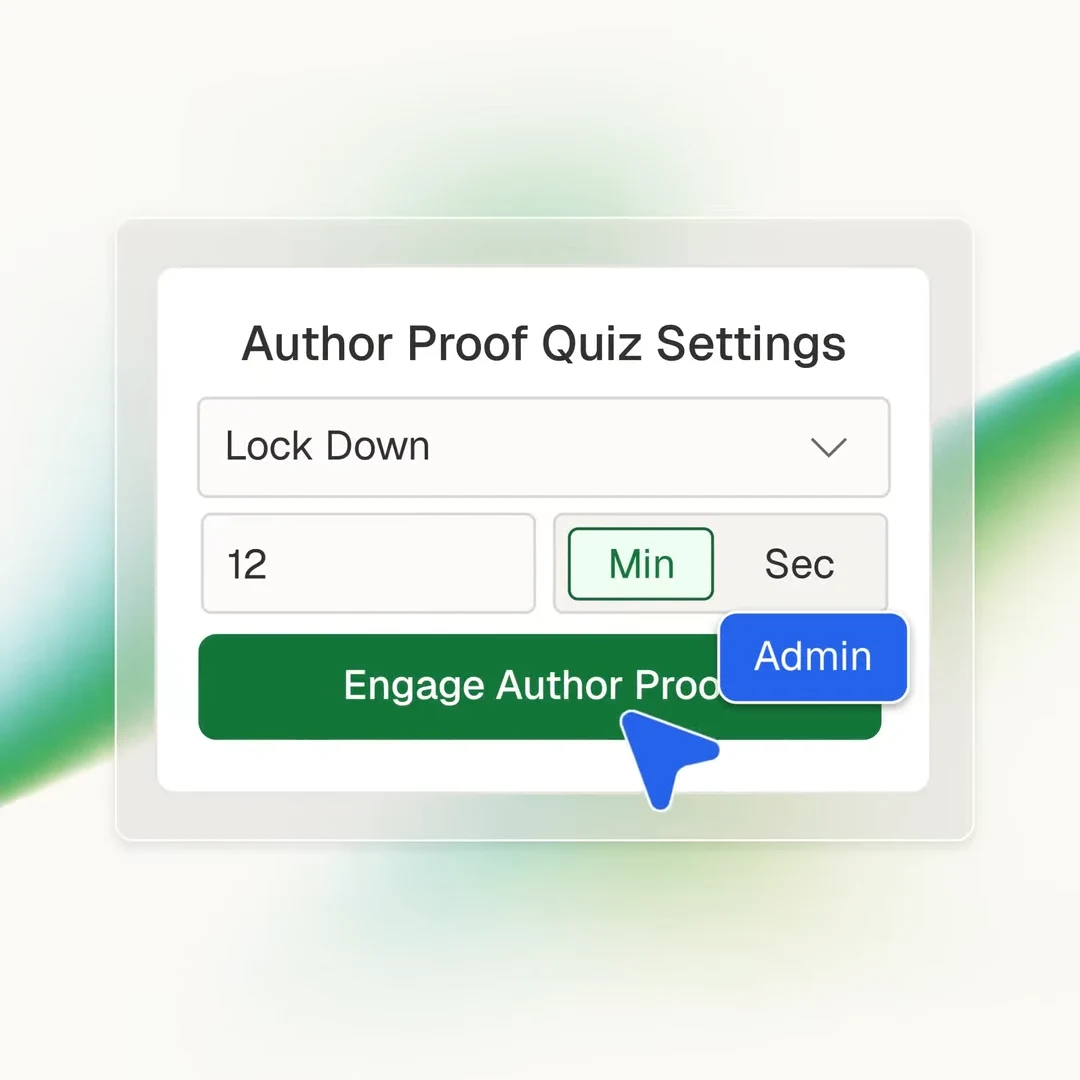
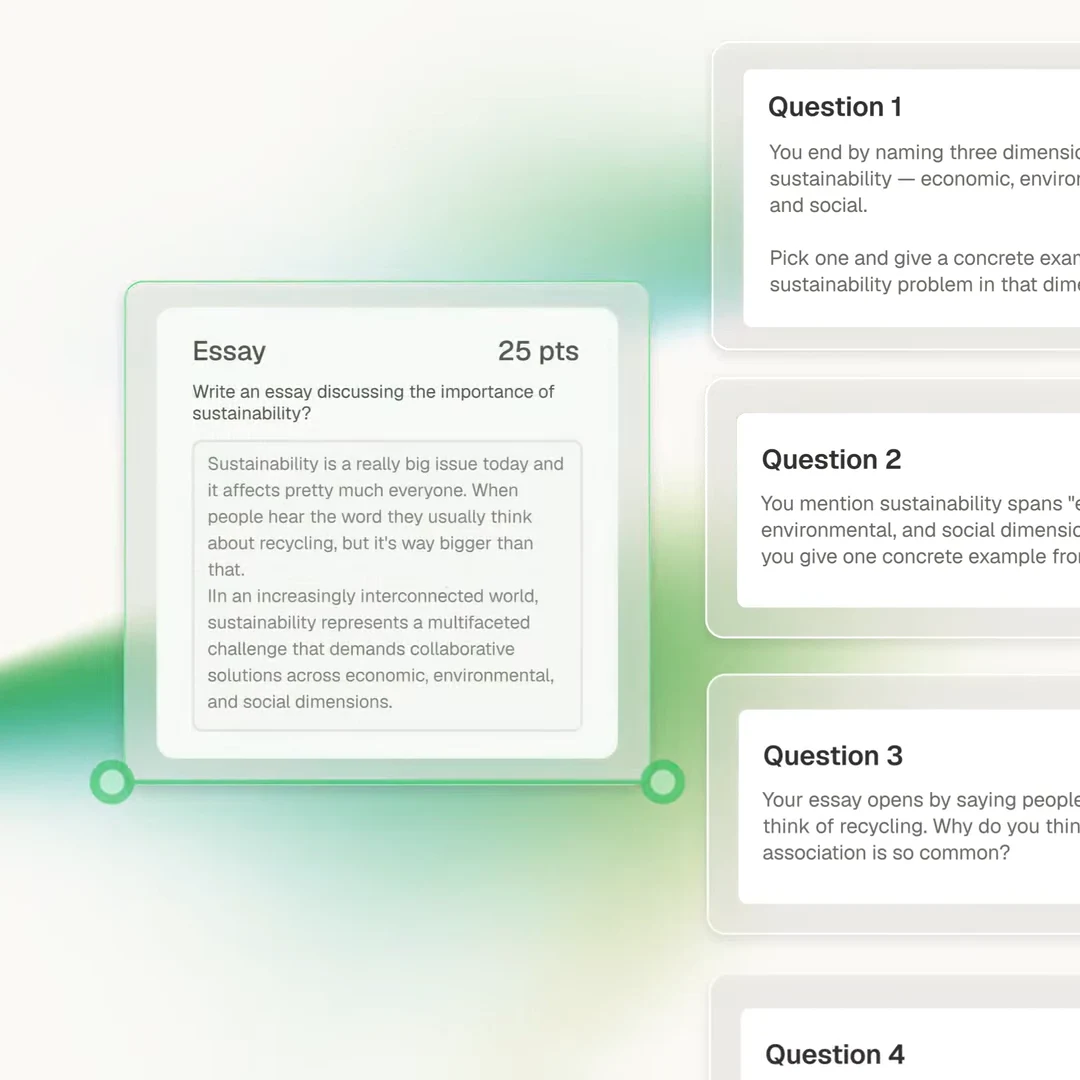
AuthorProof went to a pilot with about 5 institutions in spring 2026. The goals for that first semester: 95% of test takers finish their quiz, and fewer than 5% of results are false positives.
What I'd do next
- 01Test it with proctoring sooner.
Prototype the embedded flow beside a proctored session before the direction decision, not after.
- 02Let instructors review questions.
Before a generated quiz reaches a student.
- 03Pick the quiz language.
Beyond the default of the submission's language.